Increase Domain Authority in 2026 5 Proven SEO Steps
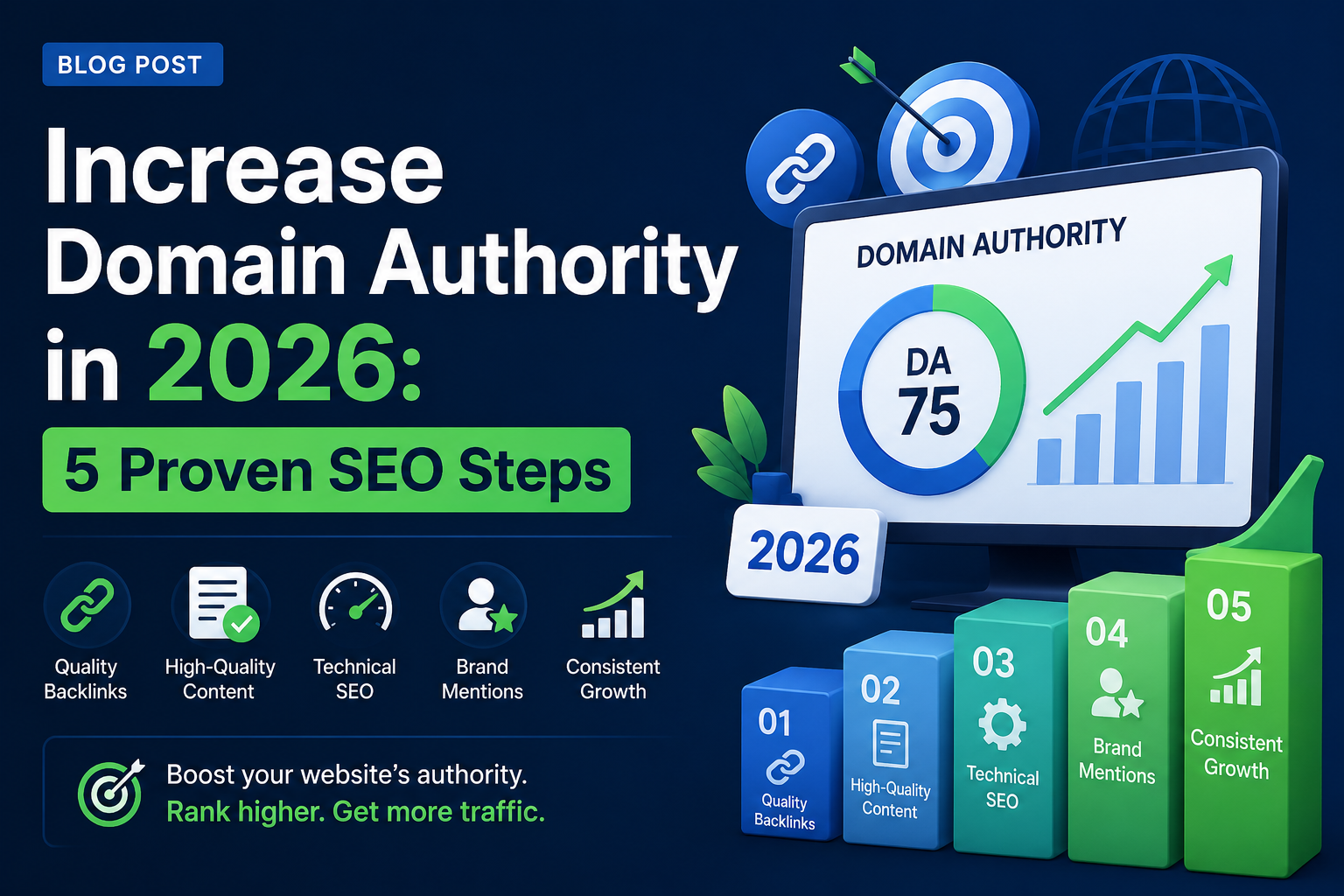
How to Increase Domain Authority in 2026 Top 5 Proven Steps to Boost Your Website’s SEO
Introduction
If you want to grow organic traffic, outrank competitors, and build a website that lasts, you must learn how to increase Domain Authority. In 2026, SEO is no longer about shortcuts. It is about trust, consistency, and real value. Domain Authority has become one of the most reliable indicators of how strong your website is compared to others in your niche.
Domain Authority reflects the overall credibility of your website. It is influenced by content quality, backlinks, technical SEO, and user experience. While search engines like Google do not use Domain Authority as a direct ranking factor, websites with higher authority almost always perform better in search results.
Many websites fail to increase authority because they chase quick wins. They buy cheap links, publish shallow content, or ignore technical issues. As a result, growth stalls or rankings drop after updates.
In this guide, you will learn how to increase Domain Authority in 2026 using five proven, white-hat steps. This article is written for beginners, bloggers, business owners, and SEO professionals who want long-term results, not temporary spikes.
What Is Domain Authority?
Domain Authority is a metric that predicts how likely a website is to rank in search engines compared to competitors. It is measured on a scale from 1 to 100. Higher scores indicate stronger authority.
The concept was introduced by Moz. Moz Domain Authority is calculated using multiple factors, including the number of linking domains, backlink quality, link relevance, and overall trust signals. The score is comparative, meaning it is best used to measure your site against others in the same niche.
Domain Authority matters because it reflects your site’s ability to compete. If two pages are equally optimized, the one from a higher-authority domain usually ranks higher. This is why Domain Authority SEO is often discussed alongside keyword optimization.
Several factors affect DA. Backlink quality plays the biggest role, but content depth, internal linking, site structure, and technical health also contribute. Authority grows when your website consistently earns trust from users and other websites.
There are common myths about Domain Authority. One myth is that increasing DA directly increases rankings. Another is that DA can be manipulated quickly. In reality, DA improves as a result of strong SEO practices, not hacks.
Ranking refers to where a specific page appears in search results. Authority refers to the overall strength of the domain. Rankings fluctuate, but authority grows steadily over time.
Why Domain Authority Still Matters in 2026
The SEO landscape in 2026 is more competitive than ever. AI-generated content has flooded the internet, making it harder for low-quality sites to stand out. Search engines now prioritize trust, experience, and consistency.
Authority helps search engines separate reliable websites from mass-produced content. When your site demonstrates expertise and earns genuine links, it sends strong trust signals. This is especially important in competitive niches like finance, health, and technology.
Google’s quality expectations have increased. Helpful content, real experience, and strong reputation matter more than keyword tricks. Websites with strong authority recover faster from updates and maintain stable rankings.
Domain Authority creates long-term SEO growth. When your site is trusted, new pages rank faster, backlinks come naturally, and organic traffic grows consistently. This makes authority one of the most valuable assets in SEO today.
Step 1: Create High-Quality Content That Earns Trust
Content is the foundation of website SEO authority. Without strong content, no amount of link building can sustain growth.
Everything starts with search intent. You must understand why users are searching. Are they looking to learn, compare, or take action? When your content clearly satisfies intent, users stay longer and engage more.
Topical authority is critical in 2026. Instead of writing random articles, focus on building complete coverage around a topic. For example, a digital marketing site should cover SEO basics, technical SEO, link building, analytics, and updates in depth. Over time, search engines recognize your site as a trusted resource.
Content depth matters more than length. A well-explained guide with examples, screenshots, and practical steps builds trust. Shallow content hurts authority because it fails to help users.
User satisfaction is a hidden driver of authority. When readers find answers quickly, navigate easily, and return for more content, your site sends positive signals.
Content freshness also plays a role. Updating older posts with new data, better explanations, and current examples keeps them relevant. For instance, updating a 2023 SEO article for 2026 often leads to ranking improvements.
EEAT signals strengthen trust. Show real experience, author expertise, transparent contact details, and accurate information. Authority grows when users and search engines trust your content.
Step 2: Build High-Quality Backlinks Naturally
Backlinks remain one of the strongest factors to increase website authority. However, quality matters far more than quantity.
Backlinks act as votes of confidence. When a trusted site links to you, some of its authority passes through the link. This is why editorial and contextual links are so powerful.
White-hat link building focuses on earning links, not buying them. Guest posting on relevant websites works when the content adds value. A marketing blog linking to your in-depth SEO guide is far more valuable than dozens of unrelated links.
Natural link acquisition happens when your content is worth referencing. Original research, detailed tutorials, tools, and case studies attract links over time.
Editorial links are the most valuable. These are links placed naturally within content because your page adds value. They are difficult to get, but they have the strongest impact on authority.
Building backlinks in 2026 is about relationships, relevance, and consistency. When links come from trusted sources in your niche, Domain Authority grows steadily and safely.
Step 3: Strengthen On-Page SEO
On-page SEO ensures your content is clear, accessible, and optimized for both users and search engines.
Title tags should describe the page accurately and encourage clicks. Avoid over-optimization. Natural titles perform better and build trust.
Meta descriptions influence click-through rates. A clear, helpful description improves engagement, which supports authority indirectly.
Internal linking connects your content and distributes authority across your site. Linking related pages helps search engines understand topic relationships and keeps users engaged longer.
Heading structure improves readability. Logical headings guide readers and make content easier to scan.
Keyword placement should feel natural. Focus on clarity instead of repetition.
Image optimization improves speed and accessibility. Compressed images with descriptive alt text enhance user experience.
User experience signals like time on page and bounce rate reflect content quality. Strong engagement supports long-term authority growth.
Step 4: Improve Technical SEO
Technical SEO provides the infrastructure that supports authority growth.
Website speed is critical. Slow pages frustrate users and reduce trust. Optimizing images, scripts, and hosting improves performance.
Mobile optimization is essential. Most users browse on mobile devices. A responsive design ensures usability across screens.
Core Web Vitals measure real user experience. Improving loading speed, visual stability, and interactivity strengthens trust signals.
HTTPS is mandatory. Secure websites appear more credible and protect user data.
XML sitemaps help search engines discover and index content efficiently. Keeping them updated ensures better crawl coverage.
Crawlability and indexability ensure search engines can access your pages. Fixing broken links and redirect chains prevents authority loss.
Structured data helps search engines understand your content. While it does not directly increase authority, it improves visibility and click-through rates.
Step 5: Update and Promote Existing Content
Updating existing content is one of the fastest ways to improve Domain Authority.
Content refresh strategies focus on improving what already exists. Updating outdated sections, adding examples, and improving structure often lead to ranking gains.
Statistics should always be current. Outdated data reduces credibility and trust.
Republishing refreshed content with updated timestamps can increase visibility and engagement.
Promotion matters. Sharing updated content through newsletters, communities, and social platforms increases reach.
Email marketing brings returning users, which strengthens engagement signals.
Content distribution ensures your best work gets seen, linked, and shared, accelerating authority growth.
How to Measure Domain Authority Using Moz and Ahrefs
Moz Domain Authority measures the overall strength of a domain based on link data and predictive algorithms. It is best used for competitive comparison.
Ahrefs Domain Rating measures the strength of a website’s backlink profile. It focuses heavily on link quality and quantity.
Domain Rating vs Domain Authority is not about which is better. They use different data sources and calculations. Monitoring both gives a clearer picture.
Beginners can check scores by entering their domain into Moz or Ahrefs tools. These platforms also show linking domains and link quality.
Using Moz, you can compare your DA against competitors and identify gaps. Ahrefs allows deeper backlink analysis and growth tracking.
Tracking authority monthly helps you understand progress. Small, steady improvements indicate healthy growth.
Complete Backlink Building Strategy for 2026
Guest post backlinks come from publishing content on relevant websites. They provide strong contextual value when done correctly.
Niche edit backlinks involve adding links to existing content where relevant. They work well when the context matches naturally.
Resource page links come from curated lists of helpful content. These links are often high-quality and long-lasting.
Editorial links are earned naturally when others reference your content. They carry the highest SEO value.
Digital PR links come from news mentions and data-driven content. They are powerful but require effort and creativity.
HARO alternatives connect experts with journalists. Providing expert insights can earn authoritative links.
Business directory links help establish legitimacy, especially for local businesses.
Local citation links strengthen trust signals for location-based websites.
Profile links help diversify link profiles but should be used moderately.
Web 2.0 links support brand presence but should never be overused.
Forum links work when you genuinely contribute value to discussions.
Social signals increase visibility and indirectly support link acquisition.
Image submission links help when original visuals are shared and credited.
Broken link building replaces dead links with your content, benefiting both parties.
Competitor backlink replication identifies link sources your competitors already trust.
Monthly Backlink Growth Plan
Month one focuses on foundations. This includes profile creation, basic citations, and publishing strong core content assets.
Month two involves guest posting and targeted outreach. At this stage, relevance matters more than volume.
Month three shifts toward authority links and digital PR efforts. This is where momentum builds.
Months four to six focus on scaling naturally. As content and reputation grow, links come more organically. Natural link velocity is essential. Sudden spikes look unnatural and risky.
Recommended Backlink Quantity Table
| Website Age | Recommended Monthly Link Acquisition Range |
|---|---|
| 0–3 Months | 5–15 high-quality links |
| 3–6 Months | 15–30 high-quality links |
| 6–12 Months | 30–60 high-quality links |
| 1+ Year | 50+ natural links based on growth |
Quality always matters more than quantity. One strong link can outperform dozens of weak ones.
Toxic Backlinks to Avoid
Avoid the following backlink types because they can damage authority and trigger penalties:
- PBN links and private networks
- Link farms and auto-generated links
- Spam blog comments and mass forum spam
- Cheap paid links from unknown sellers
Google’s algorithms are highly effective at detecting manipulation. Protecting authority means avoiding risky tactics.
Best SEO Tools for Increasing Domain Authority
Moz helps track Domain Authority and analyze competitors. It is beginner-friendly and useful for benchmarking.
Ahrefs excels at backlink analysis and competitor research. It helps identify link opportunities and monitor growth.
Google Search Console shows how Google views your site. It helps identify crawl issues and indexing problems.
Google Analytics tracks user behavior. Engagement insights support content and UX improvements.
Semrush offers keyword research, competitor analysis, and backlink tracking.
Screaming Frog audits technical SEO issues like broken links and redirects.
Each tool supports authority growth when used consistently and strategically.
Common Mistakes That Prevent Domain Authority Growth
Many site owners focus only on links and ignore content quality. Others publish inconsistently or ignore technical SEO.
Over-optimization, poor internal linking, and chasing low-quality backlinks also slow growth.
Authority grows when SEO efforts are balanced and long-term.
Realistic Timeline for Increasing Domain Authority
Beginners should expect slow but steady progress. New sites may see small gains in three to six months.
Authority takes time because trust must be earned. Consistency matters more than speed.
Established sites often see faster improvements, but even then, growth is gradual.
Long-term SEO success comes from patience and discipline.
Domain Authority Growth Checklist
Use this simple checklist to stay focused:
- Publish helpful, in-depth content consistently
- Earn relevant, white-hat backlinks naturally
- Maintain strong technical and on-page SEO
Conclusion
Learning how to increase Domain Authority in 2026 requires a shift in mindset. Authority is not built through shortcuts. It grows through quality content, strong backlinks, technical excellence, regular updates, and long-term consistency.
When you focus on helping users and earning trust, authority becomes a natural outcome. Start small, stay consistent, and build a website that search engines and users trust for years to come.