Merging Industries in the USA in 2026 How Cross-Industry Collaboration Is Reshaping the American Economy
The Disappearance of Industry Boundaries in America
The American economy in 2026 looks noticeably different from what it was even a decade ago. The most striking change is not just technological advancement or economic expansion, but the gradual fading of boundaries that once separated entire industries. Businesses that once operated in isolation are now deeply interconnected, sharing data, tools, talent, and even customers in ways that were previously unimaginable.
This shift is not happening by accident. It is the result of a fast-moving digital economy where innovation rarely stays confined within a single sector. A healthcare company now behaves like a technology firm. A bank operates like a software platform. An automobile manufacturer builds itself around data analytics and artificial intelligence. These changes reflect a larger reality: industries are no longer standing alone—they are merging into shared ecosystems.
The idea of Merging Industries in the USA in 2026 captures this transformation clearly. It describes a business environment where collaboration is no longer optional but necessary for survival. Companies that once competed within their own sectors are now partnering across fields to stay relevant in a rapidly evolving marketplace.
At the center of this shift lies a combination of powerful forces: artificial intelligence, automation, digital transformation trends, sustainability pressures, and rising consumer expectations. Together, they are reshaping how value is created and delivered across the American economy.
Understanding Industry Convergence in the Modern American Economy
Industry convergence refers to the blending of two or more traditionally separate industries into shared systems, services, or technologies. In 2026, this phenomenon has become one of the most influential drivers of economic transformation in the United States.
The reason behind this shift is simple: modern problems are too complex for isolated solutions. Businesses can no longer rely solely on internal expertise when innovation increasingly depends on data, connectivity, and cross-functional capabilities.
For example, a healthcare provider today may depend on cloud computing companies, data analytics firms, and artificial intelligence platforms to deliver better patient outcomes. Similarly, financial institutions rely on cybersecurity experts, behavioral analytics tools, and fintech platforms to improve customer trust and operational efficiency.
This blending of industries is accelerating because digital ecosystems now connect nearly every sector. Cloud infrastructure allows seamless data sharing. Artificial intelligence enables real-time decision-making. Automation reduces operational barriers. As a result, industries are not just cooperating—they are becoming interdependent.
This trend, widely recognized as Industry convergence USA 2026, is redefining competition. Companies are no longer measured only by how strong they are within their sector, but by how effectively they collaborate across sectors.
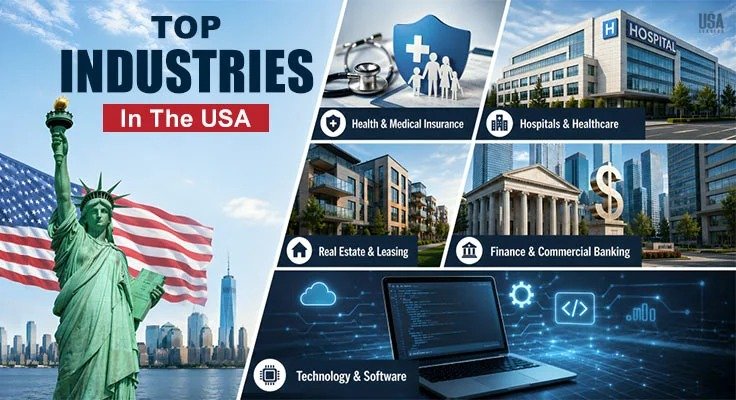
Top Industries in the USA in 2026
The American economy in 2026 is shaped by rapid innovation, digital transformation, and cross-sector collaboration. Several industries are leading this shift and setting the direction for long-term growth. These sectors are not operating in isolation anymore; instead, they are deeply connected through technology, data, and shared ecosystems.

One of the most influential areas is technology and healthcare integration, where hospitals, biotech firms, and digital platforms are working together to improve patient care and treatment accuracy. This combination has become a core driver of Merging Industries in the USA in 2026, especially as artificial intelligence continues to reshape diagnostics and personalized medicine.
Another dominant sector is fintech and banking evolution, which is redefining how Americans manage money. Digital-first financial platforms, AI-powered risk systems, and instant payment networks are replacing traditional banking limitations. This shift is also closely tied to AI-driven industries, which are improving security, automation, and customer experience across financial services.
The rise of smart manufacturing USA is also transforming the industrial backbone of the country. Factories are now powered by robotics, cloud computing, and real-time analytics systems that improve efficiency and reduce operational waste. This has made manufacturing one of the most competitive and innovative sectors in the United States.
At the same time, renewable energy and sustainability industries are expanding rapidly. Solar, wind, and energy storage companies are collaborating with infrastructure and technology providers to build cleaner and more efficient energy systems. This growth is strongly connected to emerging business sectors in America, where sustainability is becoming a major investment priority.
The media and entertainment industry is also evolving through digital transformation trends 2026, where streaming platforms, gaming companies, and immersive content developers are merging technology with storytelling. This has created entirely new revenue models and global audience engagement strategies.
Finally, logistics, retail, and e-commerce remain among the strongest contributors to economic growth. These industries are deeply integrated with data analytics, automation systems, and supply chain technologies, creating seamless customer experiences across digital and physical channels.
One of the most impactful examples of cross-industry collaboration is the growing relationship between technology companies and healthcare organizations. The healthcare sector in the United States has always been complex, but in 2026 it is undergoing a significant transformation driven by digital innovation.
Technology firms are working closely with hospitals, clinics, and research institutions to improve diagnostics, patient monitoring, and treatment outcomes. Artificial intelligence plays a central role in this evolution, helping doctors analyze medical data with greater speed and accuracy than ever before.
Telemedicine has also become a standard part of healthcare delivery rather than an alternative option. Patients can now consult specialists remotely, access medical records digitally, and receive real-time health monitoring through wearable devices connected to advanced platforms.
What makes this integration powerful is personalization. Instead of generalized treatments, healthcare providers are increasingly able to design patient-specific care plans based on genetic data, lifestyle patterns, and predictive analytics.
This level of precision would not be possible without collaboration between healthcare experts and technology engineers. The merging of these fields is not just improving efficiency—it is redefining what modern healthcare looks like in the United States.
Fintech and Banking Evolution: The Reinvention of Financial Systems
The financial industry has experienced one of the most dramatic transformations in the era of merging industries. Traditional banking systems are now deeply integrated with fintech platforms and artificial intelligence technologies, creating a more dynamic and customer-focused financial ecosystem
.
In 2026, digital payments dominate everyday transactions. Customers expect seamless, instant, and secure financial experiences, whether they are transferring money, applying for loans, or managing investments.
Artificial intelligence has become essential in this transformation. Banks now use intelligent systems to detect fraud patterns, assess credit risk, and personalize financial services. Instead of relying solely on historical data, institutions can now analyze real-time behavior to make faster and more accurate decisions.
Fintech companies, on the other hand, bring agility and innovation to the sector. They challenge traditional banking models by offering user-friendly platforms, lower fees, and faster services. As a result, banks are no longer competing only with each other—they are collaborating with technology startups to stay competitive.
This fintech and banking evolution reflects a broader trend in Merging Industries in the USA in 2026, where collaboration is replacing competition as the primary driver of innovation.
Automotive Industry Meets Software, AI, and Clean Energy
The automotive industry is no longer just about building vehicles. It has transformed into a complex ecosystem involving software engineering, artificial intelligence, and renewable energy integration.
Modern vehicles are essentially digital platforms on wheels. They rely on software updates, real-time navigation systems, autonomous driving capabilities, and predictive maintenance tools. This transformation has created deep partnerships between automobile manufacturers and technology companies.
Artificial intelligence is particularly important in this shift. Self-driving systems, traffic prediction models, and driver assistance technologies all depend on AI-driven decision-making processes. At the same time, cloud computing enables vehicles to stay connected to larger transportation networks.
Another major influence is the integration of renewable energy. Electric vehicles have created strong connections between automotive companies and energy providers. Charging infrastructure, battery innovation, and energy storage solutions are now shared responsibilities across industries.
This convergence is reshaping transportation in the United States. Cars are becoming smarter, cleaner, and more connected than ever before, driven by collaboration between industries that once operated independently.
Smart Manufacturing: The Fusion of Robotics, Cloud Computing, and Data Analytics
Manufacturing in the United States is undergoing a deep structural change. The traditional factory model is being replaced by intelligent production environments powered by robotics, cloud computing, and advanced analytics.
Smart manufacturing is not just about automation. It is about creating systems that can think, adapt, and optimize themselves in real time. Machines are now connected through digital networks that allow manufacturers to monitor production efficiency, detect issues before they occur, and adjust operations instantly.
Cloud computing plays a critical role in this transformation. It enables manufacturers to store and process massive amounts of operational data, which can then be analyzed to improve productivity and reduce waste.
Robotics has also evolved significantly. Instead of performing repetitive tasks alone, modern robots work alongside humans in collaborative environments. These systems improve precision while maintaining flexibility in production lines.
This integration of technologies reflects the essence of smart manufacturing USA, where multiple industries come together to create more efficient and resilient production systems.
Retail, Logistics, and Technology: Redefining Customer Experience
Retail has also become a major example of industry convergence. In 2026, retail businesses are no longer isolated storefronts or online platforms. They are part of a larger digital ecosystem that includes logistics providers, data analytics companies, and technology platforms.
Customer expectations have changed dramatically. People now expect fast delivery, personalized recommendations, and seamless shopping experiences across multiple channels. To meet these demands, retailers rely heavily on logistics networks powered by real-time tracking systems and predictive analytics.
Technology companies play a key role in this transformation by developing platforms that connect inventory systems, delivery networks, and customer data. This allows businesses to optimize supply chains and improve efficiency at every stage of the shopping journey.
As a result, retail has evolved into a highly integrated system where customer experience depends on collaboration across multiple industries.
Renewable Energy Partnerships Driving Sustainability
The push toward sustainability has created strong collaboration between renewable energy companies, infrastructure developers, and technology firms. In 2026, clean energy is no longer a separate sector but a shared responsibility across industries.
Energy companies are working with technology providers to improve grid management and energy distribution. Infrastructure firms are building systems that support large-scale renewable adoption. Businesses across all sectors are investing in sustainability solutions to meet regulatory requirements and consumer expectations.
This collaboration is not only environmentally significant but economically powerful. It is creating new investment opportunities, driving innovation, and reshaping industrial priorities across the United States.
Media, Entertainment, and Technology Convergence
The entertainment industry has also experienced a major transformation through integration with technology. Streaming platforms, virtual reality systems, and interactive media experiences are changing how audiences consume content.
Media companies now rely heavily on data analytics to understand viewer preferences. Technology firms provide the infrastructure needed for content delivery, personalization, and immersive digital experiences.
This convergence has opened new revenue streams and creative opportunities. Content is no longer passive—it is interactive, personalized, and data-driven.
Economic Impact of Industry Merging in the USA
The merging of industries has significantly influenced the American economy. It has increased productivity by enabling companies to operate more efficiently across sectors. Innovation has accelerated as businesses combine expertise from different fields to create new solutions.
Investment opportunities have also expanded. Investors are now looking beyond traditional industry boundaries and focusing on companies that operate within interconnected ecosystems.
However, this transformation has also introduced new challenges. Competition has become more complex, requiring companies to adapt quickly to changing market conditions.
Challenges in a Merging Industry Landscape
Despite its advantages, industry convergence brings challenges. Regulatory frameworks often struggle to keep up with rapid innovation. Data privacy concerns have become more significant as companies share information across platforms.
Cybersecurity risks have also increased due to interconnected systems. A vulnerability in one sector can now affect multiple industries.
Talent shortages remain another concern. Businesses require professionals who understand multiple fields, including technology, business strategy, and data science.
Cultural integration is also a challenge when companies from different industries merge their operations and work styles.
Opportunities for Small and Medium Businesses
Small and medium-sized businesses are not left behind in this transformation. In fact, they are often more flexible and better positioned to adapt quickly to industry convergence.
By adopting digital tools and forming strategic partnerships, smaller companies can access markets and capabilities that were previously out of reach. Cloud platforms, AI tools, and digital marketplaces have leveled the playing field, allowing smaller players to compete with larger corporations.
Future Outlook: What Comes After 2026
Beyond 2026, industry convergence is expected to deepen further. Boundaries between sectors will continue to blur as technology becomes even more integrated into daily business operations.
Companies that prioritize collaboration, adaptability, and digital transformation will be better positioned for long-term success. The future of American industries will depend on ecosystems rather than isolated organizations.
Conclusion: The New Industrial Reality of America
The concept of Merging Industries in the USA in 2026 represents more than a trend—it reflects a fundamental shift in how the economy operates. Industries are no longer separate entities but interconnected systems working together to solve complex challenges.
This transformation is creating unprecedented opportunities for innovation, growth, and collaboration. Businesses that embrace this change are likely to thrive, while those that resist it may struggle to keep pace.
The American economy is entering a new era where success depends not on isolation, but on connection.